About 197 minutes
The wrong letter — Key Ideas to Explore
Adventure Picaresque Fiction
45,300 recorded words. 37 minutes difference from this book's estimate.
View Gutenberg source #70964
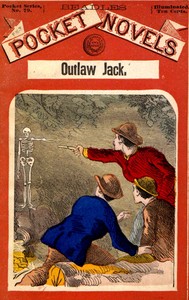
Outlaw Jack; or, the mountain devil — Story, Setting & Ideas can be approached with a clearer sense of reading commitment from its source measurements: 36,795 words, 2 hr 40 min estimated reading time, and 4 detected text sections.
The text analysis averages about 14.0 words per sentence, while the detected sections provide another way to judge how the source is divided.
Project Gutenberg metadata also associates the work with “Adventure stories,” connecting these edition facts with the source record’s subject description.
Explore this collection
These alternatives are selected using recorded categories and estimated reading time.
About 197 minutes
Adventure Picaresque Fiction
45,300 recorded words. 37 minutes difference from this book's estimate.
View Gutenberg source #70964About 240 minutes
Adventure Picaresque Fiction
54,996 recorded words. 80 minutes difference from this book's estimate.
View Gutenberg source #70755About 267 minutes
Adventure Picaresque Fiction
61,308 recorded words. 107 minutes difference from this book's estimate.
View Gutenberg source #73416Search stored excerpts and compare books → Choose by your preferences →
Choices use stored catalog measurements. Estimates vary with reading speed. A shared category is a catalog label, not a claim that two books have the same argument or literary quality.
Search reads excerpt text stored with this catalog and links to its associated Gutenberg record. The connection is stored in the site database; this tool does not recheck that every excerpt is word-for-word identical to that external record. Excerpt search does not cover every chapter and does not verify historical publication dates.
Catalog snapshot checked: 2026-09-25. Coverage: 100 public books, 100 available source excerpts.
Read the complete public-domain text at its original source.
Read on Project GutenbergThe novel begins with a deathbed scene in an emigrant camp during the 1850 California gold rush. The opening line—"Well, Burr, any change to-day?"—immediately establishes a dialogue-driven, suspenseful tone. The dying woman's cry, described as a "quavering, pitiful wail," sets a somber mood, while one listener secretly exults, hinting at hidden motives. The narrator then steps back to explain the camp's context: a chain of families toiling toward a "glittering phantom." This blend of intimate drama and panoramic exposition is typical of dime novels, inviting readers to track both personal conflicts and the broader westward movement.
The excerpts anchor the story in a specific historical moment—1850, the peak of the California gold fever. The narrator describes an "unbroken train of emigrants" stretching "almost from ocean to ocean," a hyperbolic image that underscores the scale of the migration. This setting is not merely decorative; it provides a plausible reason for the characters' isolation and vulnerability. The camp, with its "diminutive tents" and "white-tilted wagons," becomes a stage for private dramas. Readers familiar with dime novels will recognize the gold rush as a common backdrop for outlaw tales, but Badger uses it to create a sense of impermanence and danger. The dying woman's fate—burial on the prairie—foreshadows the harsh realities that await the living.
The middle excerpt shifts to a cave labyrinth, where characters Wythe and Duplin search for the wounded Jack Tyrrel. The description emphasizes disorientation: the tunnel is "low and narrow," forcing them to stoop; the torchlight is "feeble," revealing only a "jagged roof." Blood drops guide them, but the trail grows faint, and they face multiple passages. Duplin's realization—"Were they not even then lost? Lost in the labyrinth—in the bowels of the earth!"—introduces a claustrophobic dread. This spatial anxiety is a key structural device: the cave's maze mirrors the plot's twists, and the characters' "strange lack of prudence" heightens tension. Readers must navigate the same uncertainty, relying on clues like the blood trail to follow the action.
Badger relies heavily on dialogue to advance the plot and reveal character. The opening exchange between Burr and an unnamed speaker conveys information economically: the road will open, a woman is dying. Later, Wythe and Duplin's conversation in the cave mixes urgency with emotional weight—"If he is dead, somebody must pay for it!"—while also exposing their recklessness. The dialogue often includes exclamations and rhetorical questions, such as "how are we to find our way back again?" which directly involve the reader in the characters' predicament. This technique, common in serialized fiction, keeps the pace brisk and allows for cliffhangers. The excerpts show that Badger uses speech not just for exposition but to create a sense of immediacy and shared peril.
Though the excerpts are incomplete, they reveal features of the dime novel's serialized form. The opening chapter ends with a promise of revelation—"A few hasty words will explain"—that mirrors the episodic release pattern. The cave scene builds to a moment of crisis (the fear of being lost) without resolution, suggesting a chapter break. The narrator occasionally addresses the reader directly, as in "One link of the mighty human chain lies before our eyes," which creates a sense of shared observation. These structural cues help a first reader anticipate how the story unfolds: in discrete, suspenseful installments. The emphasis on physical movement (the emigrant train, the cave tunnel) also hints at a plot driven by pursuit and escape, typical of the western frontier genre.
Reading the excerpts in sequence, a first-time reader should pay attention to how Badger balances panoramic views of the gold rush with tight, dialogue-heavy scenes. The cave labyrinth, with its branching tunnels and fading blood trail, serves as a metaphor for the plot's complexity. The novel's dime-novel origins mean that action and suspense take precedence over psychological depth, but the excerpts show a deliberate craft in pacing and setting. Approach the text as a serial adventure, where each chapter builds on a cliffhanger, and the landscape—both the open prairie and the underground maze—shapes the characters' choices.
Reading Outlaw Jack, I kept losing my bearings in that cave labyrinth, each turn hinging on some fresh twist. It reminded me of that other wanderer’s tale, where drifting felt just as disorienting. There is a particular loneliness in mapped spaces that refuse to stay fixed. Captain Fly-by-Night — Key Ideas to Explore lingers with that same quiet vertigo.
Save your reaction, strongest insight, and memorable passage.