About 324 minutes
The adventuress — Story, Setting & Ideas
Fantasy Juvenile Worlds
74,425 recorded words. 1 minutes difference from this book's estimate.
View Gutenberg source #73414
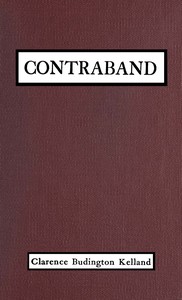
For Contraband — Key Ideas to Explore, the stored edition analysis reports 74,572 words, 5 hr 25 min estimated reading time, and 31 detected text sections.
The text analysis averages about 12.6 words per sentence, while the detected sections provide another way to judge how the source is divided.
Project Gutenberg metadata also associates the work with “Detective and mystery stories,” connecting these edition facts with the source record’s subject description.
Explore this collection
These alternatives are selected using recorded categories and estimated reading time.
About 324 minutes
Fantasy Juvenile Worlds
74,425 recorded words. 1 minutes difference from this book's estimate.
View Gutenberg source #73414About 340 minutes
Fantasy Juvenile Worlds
78,179 recorded words. 15 minutes difference from this book's estimate.
View Gutenberg source #69877About 361 minutes
Fantasy Juvenile Worlds
82,826 recorded words. 36 minutes difference from this book's estimate.
View Gutenberg source #69655Search stored excerpts and compare books → Choose by your preferences →
Choices use stored catalog measurements. Estimates vary with reading speed. A shared category is a catalog label, not a claim that two books have the same argument or literary quality.
Search reads excerpt text stored with this catalog and links to its associated Gutenberg record. The connection is stored in the site database; this tool does not recheck that every excerpt is word-for-word identical to that external record. Excerpt search does not cover every chapter and does not verify historical publication dates.
Catalog snapshot checked: 2026-09-25. Coverage: 100 public books, 100 available source excerpts.
Read the complete public-domain text at its original source.
Read on Project GutenbergThe opening pages of Contraband introduce readers not to a smuggling ring or a missing person, but to a pair of printers, Tubal and Simmy, who are lamenting the death of the old editor and the arrival of his college-educated niece. Their dialect-heavy banter—‘Wimmin,’ says Simmy, ‘hain’t got no business gittin’ all eddicated up’—sets a comic, regional tone that dominates the early chapters. The catalog subjects promise a detective story, but the excerpts suggest the mystery may be secondary to character interplay.
The excerpts are saturated with vernacular speech. Tubal and Simmy speak in a rural dialect marked by dropped g’s, double negatives, and colloquial contractions: ‘Calc’late she’ll be gifted with big words.’ This is not merely decorative; it establishes a social contrast between the printers and the educated newcomer, Carmel. The narrative voice itself remains standard English, but the dialogue carries the story’s flavor. Kelland devotes considerable space to these exchanges, suggesting that the book’s appeal lies as much in its portrayal of small-town life as in its plot. Readers should expect extended scenes of verbal comedy rather than rapid-fire action.
A later excerpt presents an extraordinary romantic confrontation between Carmel and Evan Pell, a professor-like man who announces he has fallen in love with her—but immediately declares he will not marry her. His speech is pedantic and clinical: ‘I do not wish to be in love with you… I shall take measures to affect a cure.’ Carmel’s reaction mixes anger, pity, and suppressed laughter. This scene is notable for its inversion of typical romance tropes; the male lead actively resists the relationship while the female lead remains composed. The catalog subject ‘women journalists’ is barely visible here, as Carmel’s profession is not evident in the provided text.
The Library of Congress subjects include ‘Smuggling – Fiction,’ ‘Women journalists – Fiction,’ and ‘Disappeared persons – Fiction.’ Yet the excerpts contain no smuggling, no journalism, and no missing person. Instead, they focus on a newspaper inherited by a woman (Carmel) and a printer’s struggle to produce issues. The ‘disappeared persons’ may emerge later, but the opening chapters are occupied with character comedy. This mismatch warns readers that the catalog tags describe the plot’s eventual direction, not its initial texture. The book may be a slow-burn mystery embedded in a domestic comedy of manners.
Readers approaching Contraband should set aside expectations of a fast-paced thriller. The excerpts reward attention to dialect, social comedy, and the awkward romance between a dry intellectual and a capable woman. The mystery elements, if they appear, are likely woven into this character-driven fabric. Treat the catalog subjects as distant signposts rather than a summary of the reading experience.
Sitting with Contraband, I kept thinking of that reclusive scholar’s dusty study—how much gets hidden in plain sight. It reminded me of another, stranger story where rooms hold secrets not of smuggling, but of tangled hearts and repercussions. Glenarvon, Volume 3 (of 3) — Text and Context lingers like a half-remembered melody, its older, wilder sorrows shadowing this lighter tale.
Capture what you thought, learned, and would like to remember.