About 411 minutes
The tenderfoots — A Reader’s Guide
Fantasy Juvenile Worlds
94,440 recorded words. 33 minutes difference from this book's estimate.
View Gutenberg source #73462
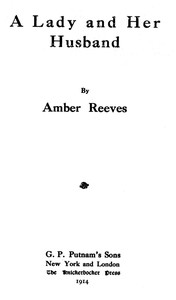
The catalog record for A lady and her husband — Background and Themes provides practical reading context through 102,047 words, 7 hr 24 min estimated reading time, and 8 detected text sections.
The text analysis averages about 17.1 words per sentence, while the detected sections provide another way to judge how the source is divided.
Project Gutenberg metadata also associates the work with “Self-actualization (Psychology) -- Fiction,” connecting these edition facts with the source record’s subject description.
Explore this collection
These alternatives are selected using recorded categories and estimated reading time.
About 411 minutes
Fantasy Juvenile Worlds
94,440 recorded words. 33 minutes difference from this book's estimate.
View Gutenberg source #73462About 388 minutes
Fantasy Juvenile Worlds
89,224 recorded words. 56 minutes difference from this book's estimate.
View Gutenberg source #70788About 364 minutes
Fantasy Juvenile Worlds
83,537 recorded words. 80 minutes difference from this book's estimate.
View Gutenberg source #70815Search stored excerpts and compare books → Choose by your preferences →
Choices use stored catalog measurements. Estimates vary with reading speed. A shared category is a catalog label, not a claim that two books have the same argument or literary quality.
Search reads excerpt text stored with this catalog and links to its associated Gutenberg record. The connection is stored in the site database; this tool does not recheck that every excerpt is word-for-word identical to that external record. Excerpt search does not cover every chapter and does not verify historical publication dates.
Catalog snapshot checked: 2026-09-25. Coverage: 100 public books, 100 available source excerpts.
Read the complete public-domain text at its original source.
Read on Project GutenbergThe opening chapter of A Lady and Her Husband establishes a psychological tension between domestic comfort and personal constraint. Rosemary Heyham, preparing to tell her mother she is in love, observes the drawing-room as a space that reveals her father's mind—'large, cheerful, excellent'—and her mother's ornamental role, 'behind the witnesses of masculine esteem.' The room itself becomes a character, reflecting the family's power dynamics. Later, Mary Heyham, the mother, faces a crisis of self-awareness after a failed interview with her husband James. She sits in a 'heavy stupor,' forcing herself to think rather than succumb to tears, and longs to escape into the night, to be 'a shadow passing unnoticed under the lamps.' The novel thus begins not with action but with interior conflict, setting up a study of a woman's struggle for agency within a marriage that offers comfort but not partnership.
The Heyhams' drawing-room is more than a setting; it is a carefully constructed stage where family roles are performed. Rosemary deliberately chooses this room for her confession because its 'publicity' makes emotional display difficult. The room's decor—'gay and luxurious, anxious to please'—mirrors her mother's social function. Mrs. Heyham sits 'behind the glittering, fire-flushed tea-things,' adorned with jewelry given by her husband and son, which 'caught the light' and rendered her face 'curiously unreal.' The space is designed for masculine approval, not genuine intimacy. When Mary later retreats to her own room after a confrontation with James, she must actively resist the comfort of tears and 'quiet resignation'—a familiar pattern—to reclaim her mental life. The domestic interior thus becomes a physical manifestation of the constraints she must overcome.
The excerpts reveal a marriage founded on asymmetry. Mary had hoped for 'a clear, close argument' and 'a fair interchange of opinion' with James, but instead their conversation becomes 'a hostile muddle.' James's external kindness—his kiss, his concern—contrasts with his refusal to engage with her ideas. He leaves her 'to struggle with her difficulties alone,' throwing her back on 'her single wit, her feeble perseverance.' Mary's internal monologue exposes her self-deprecation: she values her own strength 'so low.' Yet she also recognizes that James's mood 'baffled her, repulsed her, thrown her into confusion.' The novel thus portrays a marriage where the husband's condescension is masked by politeness, and the wife's intellectual and emotional labor is dismissed. Mary's longing to walk alone in the night, to be 'the soul of a rich woman, or of an ageing woman, nor the soul of James's' anything, underscores her desire for an identity beyond her marital role.
Despite the catalog subject 'Self-actualization (Psychology) -- Fiction,' the excerpts show Mary's journey as tentative and internal. She does not achieve a breakthrough; rather, she forces herself to 'face the question of facts' after a failed attempt to communicate with James. Her method is deliberate: 'a violent contraction of her consciousness' to avoid slipping into passive unhappiness. She clings to 'the idea of some hard, yet undiscovered duty'—a duty that is not domestic but moral and intellectual. The narrative voice tracks her mental process with precision: 'She sat in a heavy stupor, unable to check or to consider the images that formed themselves in her mind.' This is not a triumphant self-help story but a realistic portrayal of a woman's effort to think her way out of a confining situation. The novel's interest lies in the slow, painful work of self-awareness, not in its immediate results.
Readers approaching A Lady and Her Husband should attend to the psychological detail and the way domestic spaces encode social expectations. The novel rewards careful reading of its interior monologues and the subtle power plays in dialogue. Reeves's prose is precise and unsentimental, offering a portrait of marriage that is both of its time and surprisingly modern in its critique of gendered roles. The excerpts suggest a work more interested in the quiet rebellion of thought than in dramatic action.
Reading about her stiff smile over teacups, I remembered my grandmother’s silence at Sunday dinners—how she’d sharpen the carving knife just a little too long. It felt like the quiet dread in Lolly Willowes, where independence slips sideways into something stranger. Lolly Willowes — Context and Discussion held that same ache for a room of one’s own, disguised as leaves and moonlit walks.
Use these questions to collect your thoughts before moving on.