About 237 minutes
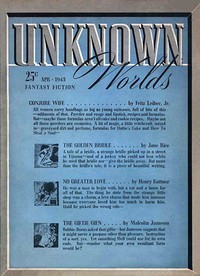
Conjure wife — A Reader’s Guide
Fantasy Juvenile Worlds
54,390 recorded words. 7 minutes difference from this book's estimate.
View Gutenberg source #70288

The catalog record for Lolly Willowes — Context and Discussion provides practical reading context through 55,945 words, 4 hr 4 min estimated reading time, and 5 detected text sections.
The text analysis averages about 16.3 words per sentence, while the detected sections provide another way to judge how the source is divided.
Project Gutenberg metadata also associates the work with “Fantasy fiction,” connecting these edition facts with the source record’s subject description.
Explore this collection
These alternatives are selected using recorded categories and estimated reading time.
About 237 minutes
Fantasy Juvenile Worlds
54,390 recorded words. 7 minutes difference from this book's estimate.
View Gutenberg source #70288About 226 minutes
Fantasy Juvenile Worlds
51,958 recorded words. 18 minutes difference from this book's estimate.
View Gutenberg source #68776About 276 minutes
Fantasy Juvenile Worlds
63,428 recorded words. 32 minutes difference from this book's estimate.
View Gutenberg source #68773Search stored excerpts and compare books → Choose by your preferences →
Choices use stored catalog measurements. Estimates vary with reading speed. A shared category is a catalog label, not a claim that two books have the same argument or literary quality.
Search reads excerpt text stored with this catalog and links to its associated Gutenberg record. The connection is stored in the site database; this tool does not recheck that every excerpt is word-for-word identical to that external record. Excerpt search does not cover every chapter and does not verify historical publication dates.
Catalog snapshot checked: 2026-09-25. Coverage: 100 public books, 100 available source excerpts.
Read the complete public-domain text at its original source.
Read on Project GutenbergFrom its first pages, Lolly Willowes establishes a voice that is both precise and slyly ironic. When Laura Willowes's father dies, her sister-in-law Caroline's thoughts immediately turn to the logistics of the spare room and the walnut bureau with false handles—a detail that tells us more about family dynamics than any direct statement could. The narrative inhabits Caroline's mind, noting that 'Lolly was a gentle creature' and that London would give her 'a better chance of marrying,' while Laura herself is not thinking at all, instead staining her wrist with crushed geranium petals. This early contrast between the bustling, practical world of the Willowes family and Laura's quiet, sensory attention to the natural world sets up the novel's central tension.
The excerpts show Laura Willowes as a woman whose inner life is expressed through small, physical gestures rather than words. While Caroline plans her future, Laura 'had picked a red geranium flower, and was staining her left wrist with the juice of its crushed petals.' This action recalls her childhood habit of staining her cheeks and bending over the greenhouse tank to see her reflection—a dark, shadowy Laura like 'the lady in the old holy painting.' The narrative does not explain these moments; it simply presents them as natural to Laura. Later, in Great Mop, she spends whole days sitting in the woods, listening to wood-pigeons and laying her cheek against a tree, expecting to hear it 'drumming like a telegraph pole.' These details suggest a character who is attuned to the nonhuman world in a way that the domestic sphere of London cannot accommodate.
The novel's subtitle, or the Loving Huntsman, finds its echo in the figure of Mr. Saunter, whom Laura meets in a muddy lane on a wet January morning. He stands bareheaded in the rain, holding 'several dead white hens'—the result of a badger's raid. His response is not anger but a gentle, explanatory smile. In his untidy living-room, he makes tea and then takes up a stocking to darn it, 'much better than she did.' Laura's reaction is to wonder what animal he resembles, but she concludes that he resembles 'no animal except man'—and that he reminds her of Adam, 'intact, with all his ribs about him.' This is a strikingly original portrait of a man: competent, gentle, and utterly at ease in his domestic and rural surroundings. The narrative treats him with the same quiet, observational irony it applies to everything else.
Though cataloged as fantasy and paranormal fiction, the excerpts from Lolly Willowes contain no overt magic, no spells, no supernatural events. Instead, the fantasy lies in the quality of attention the narrative pays to the ordinary. Laura's move to Great Mop is not presented as a flight into witchcraft but as a retreat into a world where 'the sap was rising up' and the wind 'called her out.' The prose itself becomes more lyrical in these passages: spring is 'something filial, gently unlacing the helm of the old warrior,' and wet beech-leaves 'smouldered in the woods like embers.' The only hint of the paranormal is the way Laura's perceptions shift—she sees Mr. Saunter as a new Adam, and she feels the woods as a living presence. The novel's fantasy may be less about witches than about the possibility of a life lived in deep, sensuous connection with the natural world, away from the constraints of family and society.
Readers approaching Lolly Willowes should set aside expectations of a conventional witch story. The novel's power lies in its precise, ironic prose and its patient attention to the inner life of a woman who chooses solitude and the company of trees over the demands of family. The excerpts suggest a work that is as much a social comedy as a fantasy, and one that rewards close reading of its small, telling details—the false handles on a bureau, the juice of a geranium petal, a man who darns his own stockings. Pay attention to what the narrative chooses to show and what it leaves unsaid; that is where the real magic resides.
Years on the shelf, I’ve noticed how Lolly Willowes lingers in the mind—that quiet hum of self-possession under the country air. It reminds me of another volume, one I keep shelved nearby, where a similar solitude finds its own peculiar weather. Gay Lawless — A Closer Reading holds that same unhurried pulse, a kinship felt more than spoken. Some books simply breathe together like that.
Create a short personal record of your experience with this book.