About 226 minutes
Glenarvon, Volume 3 (of 3) — Text and Context
Fantasy Juvenile Worlds
51,958 recorded words. 35 minutes difference from this book's estimate.
View Gutenberg source #68776
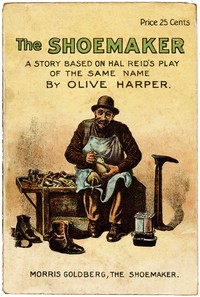
The shoemaker — Reading Notes can be approached with a clearer sense of reading commitment from its source measurements: 43,806 words, 3 hr 11 min estimated reading time, and 23 detected text sections.
The text analysis averages about 15.4 words per sentence, while the detected sections provide another way to judge how the source is divided.
Project Gutenberg metadata also associates the work with “Fathers and daughters -- Fiction,” connecting these edition facts with the source record’s subject description.
Explore this collection
These alternatives are selected using recorded categories and estimated reading time.
About 226 minutes
Fantasy Juvenile Worlds
51,958 recorded words. 35 minutes difference from this book's estimate.
View Gutenberg source #68776About 237 minutes
Fantasy Juvenile Worlds
54,390 recorded words. 46 minutes difference from this book's estimate.
View Gutenberg source #70288About 244 minutes
Fantasy Juvenile Worlds
55,945 recorded words. 53 minutes difference from this book's estimate.
View Gutenberg source #72223Search stored excerpts and compare books → Choose by your preferences →
Choices use stored catalog measurements. Estimates vary with reading speed. A shared category is a catalog label, not a claim that two books have the same argument or literary quality.
Search reads excerpt text stored with this catalog and links to its associated Gutenberg record. The connection is stored in the site database; this tool does not recheck that every excerpt is word-for-word identical to that external record. Excerpt search does not cover every chapter and does not verify historical publication dates.
Catalog snapshot checked: 2026-09-25. Coverage: 100 public books, 100 available source excerpts.
Read the complete public-domain text at its original source.
Read on Project GutenbergThe novel opens not on the frontier but in a Bowery cellar, where Morris Goldberg, a Jewish shoemaker who survived the Kishineff massacre, finds refuge. Harper’s prose lingers on the physical details of the tenement—grated windows, opened cellar-doors—and on the emotional weight of freedom for a Russian Jew. The early chapters move at a deliberate, almost documentary pace, cataloging the family’s ascent from destitution to a back-room workshop. This measured opening establishes a voice that is both sympathetic and precise, attentive to the textures of immigrant labor and domestic life.
The novel’s first half is anchored in New York’s East Side, where Harper’s narration adopts a formal, almost reportorial tone. Descriptions of the Goldbergs’ cellar home emphasize “poor but industrious” inhabitants and the “peaceful haven” of a basement workshop. The language is measured, with long sentences that accumulate detail: the shoemaker’s “patient industry,” his wife’s unspoken trauma, the daughter’s “rich coloring.” Once the story moves westward, however, the prose contracts. Dialogue becomes clipped, idiomatic, and heavily accented. Morris’s speech shifts to a Yiddish-inflected English—“I peen glat to see you”—while cowboys like Shoshone speak in terse, laconic phrases. The narrative voice itself loosens, adopting frontier rhythms and a more episodic structure. This stylistic pivot mirrors the geographical and emotional dislocation of the characters.
Harper introduces Loney, a boy who witnessed Dora’s abduction, as a narrative lens that quickens the story’s tempo. Where the early chapters unfolded slowly, Loney’s scenes are driven by dialogue and action. His exchanges with Shoshone—hand in hand, sharing breakfast—compress exposition into natural conversation. The child’s perspective filters violence and danger through a matter-of-fact lens: “Business isn’t very good in his line out here,” he says of Morris’s shoemaking. This shift in pace is reinforced by the episodic structure of the frontier sections, where characters appear and disappear rapidly. The prose becomes more cinematic, cutting between the camp, the rocks, and the two “evil faces” watching from the vines. The result is a narrative that alternates between static, interior moments and sudden, forward-moving sequences.
Harper’s use of dialect is a defining feature of the novel’s voice, particularly in the Western segments. Morris Goldberg’s speech is rendered phonetically—“Vilt Bill, he lif two hours; den he die!”—while cowboys like Shoshone speak in a plain, almost formal register. The contrast is not merely comic; it signals cultural dislocation and the shoemaker’s persistent foreignness. The dialogue also carries the plot: the dying outlaw Cactus Bill’s “paper” about a gold mine is relayed through Loney’s testimony, not through direct action. Harper relies on reported speech and hearsay to advance the search for Dora, creating a narrative that feels overheard rather than witnessed. This technique, combined with the shifting dialects, gives the novel a distinctive oral quality, as if the story were being pieced together from fragments of conversation around a campfire.
Readers should attend to the way Harper handles the transition between urban and frontier settings—not just as a change of scenery, but as a transformation in narrative method. The early chapters reward patience with their dense social observation; the later ones demand alertness to dialect and implication. The novel’s emotional center remains Morris’s voice, with its mixture of grief, determination, and fractured English. The excerpts offer no resolution, only the ongoing search.
There’s a particular ache in watching Morris Goldberg’s workshop empty out, leaving only the ghost of his daughter’s laugh. I’ve known that feeling for years—the way a story can haunt a room. Oddly, Conjure wife — A Reader’s Guide carries a similar quiet shadow, where belief itself becomes the lost thing we search for. Two dusty shelves, one long sigh.
Capture what you thought, learned, and would like to remember.