About 361 minutes
Gay Lawless — A Closer Reading
Fantasy Juvenile Worlds
82,826 recorded words. 3 minutes difference from this book's estimate.
View Gutenberg source #69655
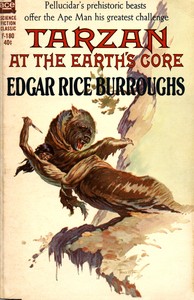
Tarzan at the Earth's core — Inside the Classic can be approached with a clearer sense of reading commitment from its source measurements: 83,537 words, 6 hr 4 min estimated reading time, and 19 detected text sections.
The text analysis averages about 22.8 words per sentence, while the detected sections provide another way to judge how the source is divided.
Project Gutenberg metadata also associates the work with “Tarzan (Fictitious character) -- Fiction,” connecting these edition facts with the source record’s subject description.
Explore this collection
These alternatives are selected using recorded categories and estimated reading time.
About 361 minutes
Fantasy Juvenile Worlds
82,826 recorded words. 3 minutes difference from this book's estimate.
View Gutenberg source #69655About 340 minutes
Fantasy Juvenile Worlds
78,179 recorded words. 24 minutes difference from this book's estimate.
View Gutenberg source #69877About 388 minutes
Fantasy Juvenile Worlds
89,224 recorded words. 24 minutes difference from this book's estimate.
View Gutenberg source #70788Search stored excerpts and compare books → Choose by your preferences →
Choices use stored catalog measurements. Estimates vary with reading speed. A shared category is a catalog label, not a claim that two books have the same argument or literary quality.
Search reads excerpt text stored with this catalog and links to its associated Gutenberg record. The connection is stored in the site database; this tool does not recheck that every excerpt is word-for-word identical to that external record. Excerpt search does not cover every chapter and does not verify historical publication dates.
Catalog snapshot checked: 2026-09-25. Coverage: 100 public books, 100 available source excerpts.
Read the complete public-domain text at its original source.
Read on Project GutenbergThe narrative structure of Tarzan at the Earth's Core hinges on the rapid dispersal of its expeditionary party. Within the first chapters, Tarzan, Jason Gridley, Captain Zuppner, and the ten Waziri warriors are scattered across Pellucidar, each forced to navigate alone. Burroughs then rotates focus among these isolated characters, a technique that sustains multiple threads of suspense. The foreword establishes Pellucidar as a hollow-earth realm reached via a mechanical prospector, but the story proper begins with the dirigible O-220 and its descent through the polar opening. From there, movement is constantly vertical—climbing cliffs, descending into caves, or traversing narrow ledges—reinforcing the layered geography of this inner world.
Burroughs repeatedly places Tarzan in the role of the silent stalker, a position that defines the novel’s point-of-view and pacing. In one extended passage, Tarzan follows an unseen beast along a winding trail, reading its weight and foot type from sound alone: “he knew that he was stalking some heavy, four-footed beast with padded feet.” The prose lingers on the mechanics of stealth—the looped grass rope, the bow and extra arrows held ready—before the quarry is revealed. This technique transforms the reader into a hunter, sharing Tarzan’s heightened senses. The payoff comes when the stalked creature is not a monster but a cave bear threatening a boy, forcing Tarzan to shift from observer to protector. The scene exemplifies how Burroughs uses predatory patience to build narrative tension, then subverts it with a chivalric intervention.
Cave entrances recur as critical spatial and symbolic thresholds. The boy is cornered at the mouth of a cave; the bear emerges from it; Tarzan approaches along the trail that ends there. Earlier, the dirigible descends through the polar opening—a kind of cave into the Earth. These apertures mark transitions between known and unknown spaces, safety and danger. Burroughs often describes them as sudden reveals: “the trail ended at the mouth of a great cave.” The cave mouth is both a dead end and a portal, compressing action into a narrow frame. This repeated motif gives the landscape a claustrophobic quality, even in the vastness of Pellucidar, and underscores the characters’ vulnerability to being trapped or ambushed.
The unnamed boy encountered by Tarzan serves a function beyond mere rescue. His presence triggers a rare moment of introspection in the ape-man, as Burroughs notes the “flame of chivalry, bequeathed him by his English parents” that compels him to act. The boy’s reaction—initial hope, then resignation when he sees Tarzan is not of his tribe—reveals the tribal divisions within Pellucidar. He stands “bravely, his spear and his crude stone knife ready,” a detail that aligns him with the primitive peoples Innes and Perry sought to civilize. Though the excerpts do not show the boy again, his introduction establishes a pattern: isolated individuals or small groups become focal points around which larger conflicts coalesce. The boy is a miniature version of the empire-building theme that runs through the series.
Burroughs orchestrates scene changes through physical travel—the dirigible O-220 provides the initial descent, but once on the ground, movement is almost entirely on foot along trails, ridges, and cave passages. The trail in the excerpt is winding, preventing Tarzan from seeing ahead; this limited visibility forces both character and reader to rely on sound and inference. The narrative itself mimics this winding path, cutting between characters at moments of crisis. Chapter titles like “Brought Down,” “The Pheliam Swamp,” and “Through the Dark Forest” signal geographic progression, but the actual transitions are abrupt, often leaving a character in peril while switching to another’s predicament. This technique maintains momentum across the 83,000-word text, compensating for the lack of a single protagonist by distributing danger among the party members.
Readers approaching Tarzan at the Earth's Core will find a story built on separation and reunion, where the landscape itself generates conflict. Pay attention to how Burroughs uses vertical space—ledges, cliffs, cave mouths—to create obstacles that are both physical and narrative. The alternating viewpoints reward patience, as threads converge only in the final chapters. The foreword provides essential context about Pellucidar’s hollow-earth premise, but the novel’s real engine is the constant, silent movement of its characters through a world that is always watching.
Re-reading this one, I kept noticing how much Burroughs trusts his readers to follow the separations, the quiet stalking. It feels less like adventure and more like remembering a long, strange dream. That same unhurried patience sits in The tenderfoots — A Reader’s Guide, which reads like someone passing along a well-worn map. Both made me want to linger at the mouth of a cave, listening to the dark inside.
Your answers remain private and are stored only in this browser.