About 364 minutes
Tarzan at the Earth's core — Inside the Classic
Fantasy Juvenile Worlds
83,537 recorded words. 3 minutes difference from this book's estimate.
View Gutenberg source #70815
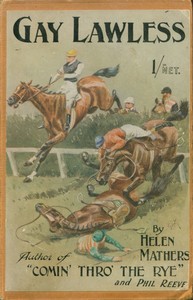
The catalog record for Gay Lawless — A Closer Reading provides practical reading context through 82,826 words, 6 hr 1 min estimated reading time, and 8 detected text sections.
The text analysis averages about 24.1 words per sentence, while the detected sections provide another way to judge how the source is divided.
Project Gutenberg metadata also associates the work with “Young women -- Fiction,” connecting these edition facts with the source record’s subject description.
Explore this collection
These alternatives are selected using recorded categories and estimated reading time.
About 364 minutes
Fantasy Juvenile Worlds
83,537 recorded words. 3 minutes difference from this book's estimate.
View Gutenberg source #70815About 340 minutes
Fantasy Juvenile Worlds
78,179 recorded words. 21 minutes difference from this book's estimate.
View Gutenberg source #69877About 388 minutes
Fantasy Juvenile Worlds
89,224 recorded words. 27 minutes difference from this book's estimate.
View Gutenberg source #70788Search stored excerpts and compare books → Choose by your preferences →
Choices use stored catalog measurements. Estimates vary with reading speed. A shared category is a catalog label, not a claim that two books have the same argument or literary quality.
Search reads excerpt text stored with this catalog and links to its associated Gutenberg record. The connection is stored in the site database; this tool does not recheck that every excerpt is word-for-word identical to that external record. Excerpt search does not cover every chapter and does not verify historical publication dates.
Catalog snapshot checked: 2026-09-25. Coverage: 100 public books, 100 available source excerpts.
Read the complete public-domain text at its original source.
Read on Project GutenbergThe novel opens with Gay Lawless declaring trotting 'the prettiest sport in the world,' a line that immediately establishes her passionate, defiant voice. Her companion Chris Hannen, a steeplechase enthusiast, responds with a 'shade of contempt,' setting up a central tension between equestrian disciplines and, by extension, between Gay’s boldness and the expectations of her social circle. The early dialogue reveals Gay’s familiarity with betting mechanics—she notes that 'the sight of gold creates a panic' in the ring—and her easy camaraderie with driver Carlton Mackrell. Yet Chris’s mental note that driving is 'about the only thing Mackrell could do' hints at underlying rivalries. The excerpts show a world where sporting skill, reputation, and gender roles are constantly in negotiation.
The climax of the excerpts centers on the Gold Vase race at Waterloo Park. Gay, forced to drive when her driver becomes drunk, wins the trophy—but the victory curdles when a newsboy’s cry announces Mackrell’s expulsion for tampering with toe weights. Gay’s reaction is visceral: 'her triumph turned to sawdust between her teeth.' The narrative dwells on her physical and emotional state: her arms ache, she sits on her bed with 'all the triumph fizzled out,' and she recognizes a 'debt of honour' to Mackrell, who apparently sacrificed his reputation for her win. The scene underscores how quickly public acclaim can become private shame, and how Gay’s impulsive choices carry consequences for others.
Lossie, a female antagonist, delivers pointed critiques that reveal the social scrutiny Gay faces. She mocks Gay’s driving posture—'Toes turned out, first position'—and implies impropriety in her attire: 'That rug, too, outlining you like a sheath.' Lossie’s accusations that Gay 'dressed for the part' and that Mackrell ‘let’ her win tap into fears of female immodesty and undeserved success. Gay’s defensive retort—'Did you ever see me befeathered on a race-course?'—shows her pride in her 'invariably neat racing garb.' The exchange highlights the double bind: a woman in a male sport must be both competent and beyond reproach, yet any deviation invites scandal.
The male characters—Chris Hannen, Carlton Mackrell, and the absent Rensslaer—are defined by their responses to Gay’s actions. Chris’s initial contempt for trotting gives way to silent observation; Mackrell’s dark face shows pleasure at Gay’s congratulations, yet he conceals his sacrifice. The narrative notes that Mackrell ‘had not said one word to her’ about the expulsion, and Gay wonders if Rensslaer knew and ‘made no sign.’ This restraint contrasts with Gay’s open emotion: she dries her tears because she ‘would not have done’ had the men been present. The men’s silence and self-control create a code of honour that Gay must learn to navigate, even as her own impulsiveness drives the plot.
Readers should attend to the novel’s careful calibration of sport as both literal competition and metaphor for social negotiation. The excerpts offer only fragments of the full story—Gay’s relationship with her brother Frank, the fate of Mackrell’s reputation, and the outcome of the romantic triangle remain unresolved. The text rewards attention to small gestures: a bowed head, a mental note, the weight of a rug. These details, rather than grand declarations, carry the novel’s emotional and ethical weight.
There are moments in Gay Lawless — A Closer Reading where the weight of a promise feels almost physical, pressing on the pages like weather. It reminded me, unexpectedly, of an older, stranger story I once lingered over—Glenarvon, Volume 3 (of 3) — Text and Context. Both carry that particular ache of debts unpaid to the heart. I found myself thinking of that novel long after, the way one does with an old letter.
A brief reflection can help important ideas stay with you longer.