About 44 minutes
Plane Jane — Text and Context
Utopias Future Societies Other Worlds
10,066 recorded words. 19 minutes difference from this book's estimate.
View Gutenberg source #73483
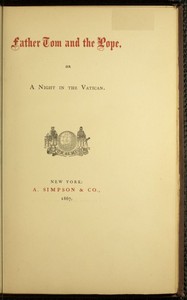
Father Tom and the Pope — A Closer Reading can be approached with a clearer sense of reading commitment from its source measurements: 14,454 words, 1 hr 3 min estimated reading time, and 2 detected text sections.
The text analysis averages about 23.2 words per sentence, while the detected sections provide another way to judge how the source is divided.
Project Gutenberg metadata also associates the work with “Clergy -- Fiction,” connecting these edition facts with the source record’s subject description.
Explore this collection
These alternatives are selected using recorded categories and estimated reading time.
About 44 minutes
Utopias Future Societies Other Worlds
10,066 recorded words. 19 minutes difference from this book's estimate.
View Gutenberg source #73483About 30 minutes
Utopias Future Societies Other Worlds
6,817 recorded words. 33 minutes difference from this book's estimate.
View Gutenberg source #73484About 160 minutes
Utopias Future Societies Other Worlds
36,578 recorded words. 97 minutes difference from this book's estimate.
View Gutenberg source #72971Search stored excerpts and compare books → Choose by your preferences →
Choices use stored catalog measurements. Estimates vary with reading speed. A shared category is a catalog label, not a claim that two books have the same argument or literary quality.
Search reads excerpt text stored with this catalog and links to its associated Gutenberg record. The connection is stored in the site database; this tool does not recheck that every excerpt is word-for-word identical to that external record. Excerpt search does not cover every chapter and does not verify historical publication dates.
Catalog snapshot checked: 2026-09-25. Coverage: 100 public books, 100 available source excerpts.
Read the complete public-domain text at its original source.
Read on Project GutenbergThe preface of this 1867 pamphlet immediately signals its satirical intent by posing a series of absurd, unresolved questions—who invented gunpowder, whether the egg or chicken came first—and citing invented authorities like Xinctillios and St. Bardolphus in mock-Latin and gibberish. The narrator then introduces Father Tom Maguire, a real Irish priest known for his oratory, high living, and fox-hunting, whose threat to convert to Protestantism if forced to give up his greyhounds sets the tone for the irreverent comedy that follows.
The work is structured as a frame narrative: after the preface, Father Tom recounts to the Pope a night of disputation in the Vatican, blending theological argument with farcical domestic details. The voice shifts between the preface's learned parody and Father Tom's vigorous Hiberno-English, creating a deliberate contrast between high-flown debate and earthy humor.
The preface establishes a tone of learned absurdity that undercuts any claim to serious theological inquiry. The narrator cites non-existent works and authors—Xinctillios's De novum ovum and St. Bardolphus's Coptic-sounding pronouncements—to parody scholastic disputation. The questions themselves are deliberately trivial: the origin of gunpowder, printing, and the chicken-or-egg problem. This rhetorical strategy prepares the reader for a narrative that will treat Catholic dogma with similar irreverence.
The preface also speculates on the pamphlet's authorship, naming Lord Brougham, the Duke of Wellington, and the Irish writer Maginn, all in a tone of mock-conspiracy. This framing device distances the work from any single authoritative voice, reinforcing its satirical nature. The narrator's claim that “common sense” cannot adopt either Roman Catholic dogmas or philosophical “folatreries” signals that the text will occupy a skeptical middle ground, using humor to expose the absurdities of both.
Father Tom's speech is rendered in a dense Hiberno-English that is both comic and precise. His recollections of school at Firdramore—bringing a “sod o' turf,” sitting on a “shnug boss o' straw,” playing “fox-and-geese” with “purty Jane Cruise”—evoke a nostalgic, earthy world that contrasts sharply with the Vatican setting. The rhythm of his narration is oral and digressive, punctuated by exclamations like “God be wid them days” and “by this and by that.”
The debate itself proceeds through a series of concrete, often domestic, actions. When Father Tom demands that the Pope's housekeeper stir a posset with her “delicate little finger,” the theological dispute is momentarily suspended for a farcical exchange about the housekeeper's appearance. The Pope's protests—“it's very unproper ov you to spake that way”—are undercut by Father Tom's insinuations, creating a pattern of escalation and deflation that drives the comedy. The algebraic and metaphysical arguments promised in the chapter title are deferred in favor of this personal sparring.
The narrative moves between two distinct paces: the leisurely, digressive reminiscences of Father Tom's youth and the rapid, back-and-forth exchanges of the Vatican dispute. The schoolroom memory, with its detailed description of seating and games, slows the narrative to a pastoral idyll, while the dialogue with the Pope accelerates into a series of quick retorts and escalating demands.
This shift is most evident in the posset-making scene. Father Tom's insistence on the “faymale hand” and the “adaptation ov the particles” parodies scientific and theological precision, but the comedy depends on the swift exchange of insults and the Pope's growing exasperation. The appearance of the “ould faggot ov a Caillean” instead of the young housekeeper is a classic farcical reversal, puncturing the pretension of the debate. The pace quickens as Father Tom refuses to be deceived, and the scene ends with the Pope reluctantly ordering the real housekeeper to be sent up—a moment that promises further comic disruption.
Readers should attend to the way the pamphlet uses its preface as a key to its satirical method: the mock-scholarly apparatus is not mere decoration but a deliberate contrast to Father Tom's vernacular energy. The work rewards attention to its linguistic play—the invented Latin, the Hiberno-English idioms, and the rhythm of oral storytelling. Because the excerpts are incomplete, the full arc of the theological and algebraic disputes remains unknown, but the pattern of farcical interruption suggests that the comedy lies less in argument than in the collision of worlds: the Vatican's formality and Father Tom's irreverent, embodied wit.
That old pamphlet left me thinking about how arguments can be both fierce and oddly tender, two stubborn souls circling each other all night. It reminded me of something quieter I keep returning to, where a voice from the past lingers without any resolution. A dead man's diary — Key Ideas to Explore carries that same weight, like a half-finished sentence you can’t quite put down.
Capture what you thought, learned, and would like to remember.