About 443 minutes
The Greene murder case — Reading Companion
Utopias Future Societies Other Worlds
101,722 recorded words. 375 minutes difference from this book's estimate.
View Gutenberg source #72719
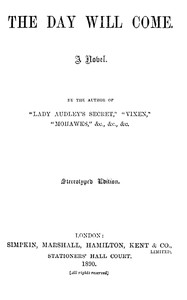
This digital edition of The day will come — A Closer Reading is described by source-level measurements including 187,977 words, 13 hr 38 min estimated reading time, and 41 detected text sections.
The text analysis averages about 20.3 words per sentence, while the detected sections provide another way to judge how the source is divided.
Project Gutenberg metadata also associates the work with “Revenge -- Fiction,” connecting these edition facts with the source record’s subject description.
Explore this collection
These alternatives are selected using recorded categories and estimated reading time.
About 443 minutes
Utopias Future Societies Other Worlds
101,722 recorded words. 375 minutes difference from this book's estimate.
View Gutenberg source #72719About 414 minutes
Utopias Future Societies Other Worlds
95,006 recorded words. 404 minutes difference from this book's estimate.
View Gutenberg source #69383About 409 minutes
Utopias Future Societies Other Worlds
94,037 recorded words. 409 minutes difference from this book's estimate.
View Gutenberg source #71002Search stored excerpts and compare books → Choose by your preferences →
Choices use stored catalog measurements. Estimates vary with reading speed. A shared category is a catalog label, not a claim that two books have the same argument or literary quality.
Search reads excerpt text stored with this catalog and links to its associated Gutenberg record. The connection is stored in the site database; this tool does not recheck that every excerpt is word-for-word identical to that external record. Excerpt search does not cover every chapter and does not verify historical publication dates.
Catalog snapshot checked: 2026-09-25. Coverage: 100 public books, 100 available source excerpts.
Read the complete public-domain text at its original source.
Read on Project GutenbergThe novel begins with a sudden clashing of joy-bells that startles rooks from elm trees above an old church, a sound that has been anticipated all afternoon. The telegraph wires have brought news of the bride and bridegroom's arrival at Wareham station, five miles off, and four horses are carrying them to Cheriton Chase. The village, having declared a half-holiday, is alive with gipsies setting up Aunt Sally on the green and a pictorial shooting-gallery with a grinning giant's face. This opening establishes a pattern of movement between remote Purbeck—cut off by a winding river and calling itself an island—and the wider world, a contrast that recurs throughout the narrative.
The joy-bells that open the novel are not merely festive; they function as a structural signal, marking the arrival of a couple and setting the village in motion. Later, the telegraph wires that gave the signal to the ringers reappear as a motif of communication and expectation. The narrative repeatedly uses such auditory cues—bells, voices, the clatter of hooves—to announce shifts in scene or mood. In the excerpt, the bells are described as breaking out with 'sudden jubilation,' yet the village had been on the alert all afternoon, creating a tension between anticipation and event. This pattern of delayed gratification and sudden release echoes through the legal and romantic plots, where characters wait for news, for a lover's arrival, or for the outcome of a case.
Braddon moves her characters across a carefully delineated geography: from the 'lonely Scottish deer-walk' of the heath to the 'Dutch landscape' of level pasture and winding stream, from the grim stone walls of Corfe Castle to the billiard-room of a country house. The opening chapter lingers on the peculiar charm of Purbeck, blending barren heath and fertile water-meadow. Later, the action shifts to a Wiltshire house 'under the dominion of a childless widow,' where the smart set gathers. These settings are not mere backdrops; they shape the characters' opportunities and constraints. Harrington, for instance, must choose between the 'shop' of his legal practice and the social world of Medlow Court, a choice that plays out in the billiard-room on a grey winter afternoon.
Waiting is a recurrent action in the excerpts. The village waits for the bride; the sisters wait for Harrington to return to society; Miss Baldwin waits for an invitation to be arranged. The narrative itself seems to mark time through these intervals. Harrington's legal studies are described as a period of 'after-midnight studies' over Coke upon Littleton, during which the household fears fire. His progress is measured by the complaints of the cook-housekeeper about coals and candles. This domestic detail grounds the abstract concept of ambition in material reality. The lovers' conversation in the billiard-room is punctuated by Sir Henry's absence—he has 'crept off to the stables'—leaving them alone to discuss the future. The scene is static, yet charged with the pressure of decisions deferred.
Images of light and darkness recur in the excerpts, often tied to knowledge or ignorance. The bells break out on a 'clear, bright air,' but the narrative also mentions 'true or false lights' that Harrington has followed through the mazes of free thought. His legal studies are conducted by candlelight, a solitary flame against the darkness. The billiard-room on a grey winter afternoon is lit only by the dim examples of early Italian paintings. These contrasts suggest a world where clarity is fleeting and motives are obscured. The telegraph wires that bring the signal for the joy-peal also carry news that may be ambiguous. Braddon uses these visual cues to create an atmosphere of uncertainty, where characters must interpret signs—a blush, a laugh, a sudden silence—as they navigate the social and legal labyrinths of the plot.
Readers attentive to the novel's structure will notice how Braddon uses the movement between village, country house, and legal chambers to create a rhythm of expectation and revelation. The recurring images of bells, lights, and waiting are not decorative but functional, building tension across the novel's 41 text sections. As you read, watch for how these patterns shift when the narrative moves indoors or into dialogue, and consider how the Dorset landscape—with its blend of heath and pasture—mirrors the characters' own divided loyalties.
That wedding peal in Cheriton brought back an afternoon on my grandmother’s porch, the same bell-tone hollowness. I found a similar quiet ache in Harvard episodes — Reading Companion, where old rooms hold their stories without telling them. Both books feel like watching light move across a floor you once knew. Not action, just residue.
Answer a few questions and save a private reflection on this device.