About 414 minutes
In Old Madras — A Closer Reading
Utopias Future Societies Other Worlds
95,006 recorded words. 5 minutes difference from this book's estimate.
View Gutenberg source #69383
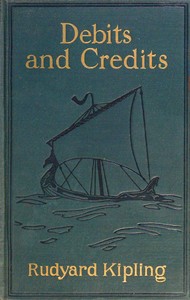
For Debits and credits — Background and Themes, the stored edition analysis reports 94,037 words, 6 hr 49 min estimated reading time, and 40 detected text sections.
The text analysis averages about 14.0 words per sentence, while the detected sections provide another way to judge how the source is divided.
Project Gutenberg metadata also associates the work with “World War, 1914-1918 -- Fiction,” connecting these edition facts with the source record’s subject description.
Explore this collection
These alternatives are selected using recorded categories and estimated reading time.
About 414 minutes
Utopias Future Societies Other Worlds
95,006 recorded words. 5 minutes difference from this book's estimate.
View Gutenberg source #69383About 386 minutes
Utopias Future Societies Other Worlds
88,565 recorded words. 23 minutes difference from this book's estimate.
View Gutenberg source #73527About 443 minutes
Utopias Future Societies Other Worlds
101,722 recorded words. 34 minutes difference from this book's estimate.
View Gutenberg source #72719Search stored excerpts and compare books → Choose by your preferences →
Choices use stored catalog measurements. Estimates vary with reading speed. A shared category is a catalog label, not a claim that two books have the same argument or literary quality.
Search reads excerpt text stored with this catalog and links to its associated Gutenberg record. The connection is stored in the site database; this tool does not recheck that every excerpt is word-for-word identical to that external record. Excerpt search does not cover every chapter and does not verify historical publication dates.
Catalog snapshot checked: 2026-09-25. Coverage: 100 public books, 100 available source excerpts.
Read the complete public-domain text at its original source.
Read on Project GutenbergKipling opens Debits and Credits with a mock-Islamic framing device in 'The Enemies to Each Other,' invoking the historian Mirza Mirkhond and the phrase 'God knows best the true state of the case.' The story immediately establishes a voice that is both learned and wry, blending scholarly apparatus with a tale of a bull-calf that 'studied their psychology' and 'was a thinker along the lines necessary to his sport.' This juxtaposition of high literary reference and earthy animal observation sets a pattern for the collection: the ledger of debits and credits is not merely financial but moral and experiential.
In 'The Enemies to Each Other,' the bull-calf Apis is described with a vocabulary usually reserved for human intelligence: he 'watched their faces to divine which way they would run,' 'used the jacket to find the boy,' and possessed 'a curious truculent mirth.' The narrator, Monsieur Voiron, explicitly compares the bull's tactical mind to that of 'our gunners' and 'our Carpentier,' grounding the animal's cunning in a post-war context where military skill and sport overlap. The bull's ability to 'side-kick as he jumps' and to 'pretend sometimes to charge directly' before wheeling unpredictably is rendered with the precision of a field report. Kipling does not anthropomorphize cheaply; instead, he insists on the bull's alien yet recognizable form of intelligence, one that 'thinks along the lines necessary to his sport.' The story's humor—the bull 'laughing, like an Apache' after nearly unseating the narrator—darkens the comedy, hinting at a world where even beasts absorb the lessons of conflict.
The collection's third story, 'In the Interests of the Brethren,' shifts from the Camargue to a Masonic lodge in London, where veterans gather for fellowship and ritual. The title itself echoes the language of mutual obligation, a counterweight to the 'debits' of war. Kipling's depiction of the lodge is dense with procedural detail—the 'gavel,' the 'tiler's' duties, the 'obligations' recited—but the emotional core lies in the unspoken need for connection among men who have seen too much. One character remarks that the lodge 'unlocks the heart, without making repentance in the morning,' a line that could serve as an epigraph for the entire volume. The story's quiet tension arises from the contrast between the rigid forms of Masonic ceremony and the fragile, improvised solace it provides. Kipling, himself a Mason, uses the lodge as a microcosm of a society trying to balance the books of war's psychological cost.
Interspersed among the prose tales are translations of Horace, each labeled with a book and ode number from a fictional 'Book V.' These poems—'To the Companions,' 'The Survival,' 'The Portent,' 'The Last Ode'—are not mere ornaments but active commentaries on the surrounding stories. 'The Survival' (Horace, Ode 22, Bk. V) speaks of enduring through change, while 'The Last Ode: Nov. 27, B.C. 8' (Ode 31, Bk. V) closes the collection with a meditation on finality. Kipling's choice of Horace, a poet of empire and personal restraint, is deliberate: the Roman's measured tones provide a classical counterpoint to the raw, often brutal narratives of the present. The translations are not literal but adaptive, bending Horace's lines to echo the war's aftermath. For instance, 'To the Companions' (Ode 17, Bk. V) addresses comrades with a warmth that feels earned rather than sentimental, bridging the ancient symposium and the modern Masonic lodge.
Debits and Credits rewards readers who attend to its structural echoes: the bull's tactical mind reappears in the strategic silences of the Masonic lodge, and Horace's stoicism undergirds the grief of 'The Gardener.' Kipling's ledger is not balanced by the end; rather, the collection insists that some accounts remain open. Approach these stories as you would a set of interlocking puzzles, where each piece—whether a bull's charge or a translated ode—modifies the meaning of the others.
Reading Debits and Credits again, I keep lingering on Kipling’s ledger metaphor—how every gain carries its quiet cost. That same weight of unspoken trade-offs hovers over In Old Madras — A Closer Reading, as if each page remembers what was given up for what was kept. It feels less like scholarship, more like sitting with an old friend who knows the price of things.
Create a short personal record of your experience with this book.