About 223 minutes
Salome Shepard, reformer — Text and Context
Utopias Future Societies Other Worlds
51,266 recorded words. 63 minutes difference from this book's estimate.
View Gutenberg source #69636
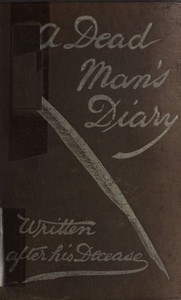
The source record for A dead man's diary — Key Ideas to Explore measures this digital text at 36,578 words, 2 hr 40 min estimated reading time, and 9 detected text sections.
The text analysis averages about 28.5 words per sentence, while the detected sections provide another way to judge how the source is divided.
Project Gutenberg metadata also associates the work with “Christian fiction,” connecting these edition facts with the source record’s subject description.
Explore this collection
These alternatives are selected using recorded categories and estimated reading time.
About 223 minutes
Utopias Future Societies Other Worlds
51,266 recorded words. 63 minutes difference from this book's estimate.
View Gutenberg source #69636About 237 minutes
Utopias Future Societies Other Worlds
54,384 recorded words. 77 minutes difference from this book's estimate.
View Gutenberg source #72316About 250 minutes
Utopias Future Societies Other Worlds
57,361 recorded words. 90 minutes difference from this book's estimate.
View Gutenberg source #69255Search stored excerpts and compare books → Choose by your preferences →
Choices use stored catalog measurements. Estimates vary with reading speed. A shared category is a catalog label, not a claim that two books have the same argument or literary quality.
Search reads excerpt text stored with this catalog and links to its associated Gutenberg record. The connection is stored in the site database; this tool does not recheck that every excerpt is word-for-word identical to that external record. Excerpt search does not cover every chapter and does not verify historical publication dates.
Catalog snapshot checked: 2026-09-25. Coverage: 100 public books, 100 available source excerpts.
Read the complete public-domain text at its original source.
Read on Project GutenbergThe anonymous narrator of A Dead Man's Diary writes from beyond the grave, presenting his account as a literal post-mortem journal. The preface by G.T. Bettany frames the work as a speculative narrative, neither claiming literal truth nor dismissing its imaginative power. The diary form allows the author to explore the afterlife through intimate, first-person reflection rather than doctrinal exposition.
The narrator's voice is notably introspective, often circling back to his earthly loves and regrets. He describes heaven not as a distant realm but as a condition of the soul, shaped by one's inner state. The prose shifts between lyrical passages—such as a dreamlike vision of his wife and child—and more analytical musings on sin, love, and the nature of God. This blend of the personal and the philosophical gives the diary its distinctive texture.
The choice of a diary format is central to the book's effect. The narrator writes as if he has truly died and returned, recording his observations in dated entries. This creates an immediacy that a treatise or sermon would lack. The preface notes that portions appeared serially in Lippincott's Monthly Magazine, suggesting the author intended the work to be read as a continuous narrative, not a collection of aphorisms.
The diary's entries vary in length and tone. Some are brief, almost note-like; others unfold into extended meditations. The narrator frequently addresses an implied reader, using phrases like "I do not ask or expect" and "you will understand." This rhetorical strategy draws the reader into a shared confidence, as if the dead man is speaking directly to us. The effect is both intimate and unsettling, since the speaker's authority derives from his supposed death.
A recurring thread in the diary is the narrator's attachment to a woman he loves and to his young son. He describes a vision of them in a cozy room, the child praying "Our Father in Heaven" with "dimpled hands" folded. This domestic scene is rendered in precise, sensory detail: the warm firelight, the pictures on the walls, the baby voice. The narrator then imagines walking with his son through a meadow and a lane, listening to a skylark and a brooklet.
These passages are among the most concrete in the excerpts. They ground the abstract subject of the afterlife in specific, earthly memories. The narrator insists that his love is not blind idolatry; he acknowledges the woman's faults and his own. This honesty about imperfection—"the pitiful paltriness of my life"—gives the love a credible, human weight. The afterlife, in this telling, does not erase memory or emotion but refines them.
The epigraph from Omar Khayyám—"I myself am Heav'n and Hell"—signals the book's central idea. The narrator does not describe a literal geography of the afterlife. Instead, he presents heaven and hell as conditions of the soul, determined by one's character and choices. This is consistent with the preface's observation that earlier writers erred in "too great detail." The author avoids the elaborate cityscapes of Swedenborg or the torments of "Letters from Hell."
The narrator's hell is not fire but the gnawing awareness of one's own failures. His heaven is not harps and clouds but the possibility of growth and reunion. He speaks of an "Ideal" toward which he and his beloved strive, despite repeated failure. This emphasis on striving rather than static reward gives the book a modern, psychological flavor. The afterlife becomes a continuation of moral and emotional development, not a final judgment.
G.T. Bettany's preface is worth examining as a framing device. He situates the book within a tradition of afterlife literature, from Swedenborg to Archdeacon Farrar. He notes that the human mind "cannot choose but speculate" on the future state, yet no one has the right to claim the last word. This cautious endorsement allows the reader to approach the diary as a serious imaginative exercise, not a heresy or a joke.
Bettany also reveals that the author prefers to remain anonymous, though his essays and stories were well received on both sides of the Atlantic. This anonymity reinforces the diary's conceit: the narrator is everyman, not a famous divine. The preface thus prepares the reader for a work that is personal rather than authoritative, exploratory rather than dogmatic. It is a useful entry point for understanding the book's ambitions and limitations.
Readers should approach A Dead Man's Diary as a work of imaginative theology rather than a literal account. The diary form and the anonymous narrator invite us to consider the afterlife as a mirror of our own inner lives. The book rewards attention to its language—the rhythm of its sentences, the precision of its domestic scenes, the honesty of its self-examination. It is a quiet, thoughtful book that asks not for belief but for reflection.
Reading that anonymous diary, I kept thinking how strange it is that we imagine heaven and hell as places we go, when the narrator finds them already inside him. It reminded me of another quiet book I once came across, Debits and credits — Background and Themes, where accounts are settled not in ledgers but in the weight a person carries. Both felt like gentle reckonings.
A brief reflection can help important ideas stay with you longer.