
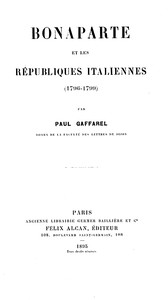
Bonaparte et les Républiques Italiennes (1796-1799) by Paul Gaffarel
Most stories about Napoleon in Italy focus on the battles—the lightning campaigns, the brilliant maneuvers at Lodi or Arcole. Paul Gaffarel’s book starts where those stories end. It’s about the peace, or rather, the chaotic attempt to build one.
The Story
After smashing the Austrian and Piedmontese armies in 1796-97, the young General Bonaparte faced a problem bigger than any enemy army: what to do with Italy. His solution was to create new states, the 'Italian Republics' (like the Cisalpine and Ligurian Republics), modeled on revolutionary France. The book tracks this three-year experiment. We see Napoleon negotiating with local patriots, drafting constitutions, and trying to balance the ideals of liberty with the harsh demands of French war policy. It’s a story of political improvisation, filled with idealistic proclamations, backroom deals, and the constant tension between liberation and exploitation.
Why You Should Read It
This book completely changed how I see this period. It paints Napoleon in a fascinating light—not yet the all-powerful emperor, but a powerful yet constrained figure. You see his pragmatism and his vision clashing daily. The most compelling parts are about the Italian revolutionaries themselves. They weren't just passive bystanders; they were active players with their own dreams, often frustrated by the very French 'liberators' they welcomed. Gaffarel shows the birth pangs of modern Italian nationalism, all filtered through the overwhelming force of Napoleon's personality and France's hunger for resources. It’s a masterclass in how messy and contradictory the spread of revolution can be.
Final Verdict
Perfect for history buffs who enjoy seeing the human and political drama behind the big events. If you’ve only read military histories of Napoleon, this is the essential companion that explains what he was fighting *for*. It’s also great for anyone interested in the messy beginnings of modern nations. Fair warning: it’s an older, academic work, so the prose isn’t flashy, but the story it tells is utterly gripping. You come away understanding that building a new world is often more complicated than conquering the old one.
No rights are reserved for this publication. Access is open to everyone around the world.
Daniel Williams
1 year agoI have to admit, it challenges the reader's perspective in an intellectual way. Exactly what I needed.
Lisa Miller
1 year agoBased on the summary, I decided to read it and the arguments are well-supported by credible references. Don't hesitate to start reading.
Kenneth King
1 year agoFive stars!
Ava Hill
4 months agoSolid story.




Elizabeth Harris
9 months agoAfter finishing this book, the character development leaves a lasting impact. I will read more from this author.