
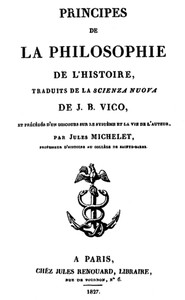
Principes de la Philosophie de l'Histoire by Giambattista Vico
Let's be honest, the title 'Principles of the Philosophy of History' sounds like a university textbook. But Vico's project is anything but dry. He wasn't just listing events; he was trying to find the engine that drives them all.
The Story
There isn't a plot with characters, but there is a powerful argument. Vico presents a bold theory: human history isn't random, and it doesn't just get better and better. Instead, every nation goes through a predictable cycle. It starts in an 'Age of Gods,' where people explain the world through myth and fear, ruled by strongmen. This evolves into an 'Age of Heroes,' with aristocratic rule and epic poetry. Finally comes the 'Age of Men,' where reason, democracy, and commerce take over. But here's the kicker: Vico thought this rational age carries the seeds of its own downfall—skepticism, complexity, and conflict can lead to a collapse, a 'ricorso,' that sends society spiraling back to a new primitive start, ready to run the cycle again.
Why You Should Read It
Reading Vico is like putting on a pair of glasses that suddenly make the past—and the present—sharper. His ideas feel startlingly modern. When you look at the rise and fall of empires, or even the life cycle of online communities and cultural trends, you can see his cycles at play. He connects everything: language, law, poetry, and politics, showing how they evolve together. It's a unified theory of human culture. It makes you think differently about news headlines and why certain stories or political movements resonate. You start seeing patterns where others see chaos.
Final Verdict
This book is perfect for curious minds who love big ideas—fans of writers like Yuval Noah Harari or Jared Diamond will find a fascinating ancestor in Vico. It's also great for anyone tired of simple, 'progress is inevitable' narratives. Be warned, it's a challenging read from the 18th century, so a good translation with notes is key. But if you're willing to wrestle with it, Vico offers a profound and strangely comforting framework: our struggles aren't new, they're part of an ancient, repeating human story. It's history as a grand, sometimes tragic, but always intelligible drama.
There are no legal restrictions on this material. Enjoy reading and sharing without restrictions.
Thomas Davis
2 years agoHaving read the author's previous works, the objective evaluation of the pros and cons is very refreshing. Simple, effective, and authoritative – what else could you ask for?
Joseph Perez
10 months agoA brilliant read that I finished in one sitting.
George Lee
4 months agoI appreciate how this edition approaches the core problem, the chapter on advanced strategies offers insights I haven't seen elsewhere. I appreciate the effort that went into this curation.
Richard Hernandez
2 months agoExceptional clarity on a very complex subject.



Jennifer Wilson
1 year agoI was skeptical about the depth of this book at first, but it manages to maintain a consistent flow even when discussing difficult topics. A trustworthy resource that I'll keep in my digital library.