
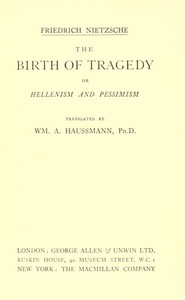
The Birth of Tragedy; or, Hellenism and Pessimism by Friedrich Wilhelm Nietzsche
Okay, let's break this down. 'The Birth of Tragedy' isn't a novel with a plot in the usual sense. Think of it as Nietzsche's origin story for Western art. He starts with two opposing forces in ancient Greece: the Apollonian and the Dionysian. Apollo represents the world of beautiful illusions—think serene statues, clear forms, and the stories we tell ourselves to make life orderly. Dionysus is his chaotic opposite: the god of wine, music, and raw, ecstatic feeling that breaks down the individual self.
The Story
The 'story' is how these two forces, which seem like total enemies, came together to create something new. Greek tragedy, for Nietzsche, was the perfect mix. The structured plot and characters (Apollo's domain) met the overwhelming, musical chorus that pulled the audience into a shared, almost primal experience (Dionysus's gift). This wasn't entertainment; it was a ritual where people faced the painful, chaotic truth of life and, for a moment, said 'yes' to it all. Then, Nietzsche says, it got ruined. Enter Socrates and his followers, who valued cool reason and logic above all else. They asked 'Why?' and dissected the magic. The tragic spirit, which embraced mystery and suffering, was replaced by optimistic philosophy. The art died.
Why You Should Read It
You should read this because it makes you look at art—music, theater, even movies—completely differently. It's not about 'messages' or moral lessons. Nietzsche argues the best art hits you on a gut level, connecting you to something bigger than yourself. His love for the chaotic, creative power of Dionysus is contagious. It's a call to break out of purely logical thinking and rediscover passion. Even if you disagree with him (and many have), his ideas are like intellectual sparks. You'll start seeing the Apollonian and Dionysian everywhere, from a perfectly composed painting to a sweaty, loud concert.
Final Verdict
This book is perfect for anyone who loves big, bold ideas about art, culture, and why we create. It's for the philosophy-curious reader who doesn't mind a challenging but thrilling argument. If you've ever felt that pure logic misses the point of life, or if you've been moved to tears by a song without knowing why, Nietzsche is talking to you. Fair warning: it's dense in spots and his later work evolved beyond this. But as a starting point to one of history's most provocative minds, and as a passionate defense of art's raw power, it's absolutely worth your time.
There are no legal restrictions on this material. You can copy, modify, and distribute it freely.
James Harris
2 years agoRight from the opening paragraph, the objective evaluation of the pros and cons is very refreshing. A perfect balance of theory and practical advice.
Patricia Anderson
1 year agoIt effectively synthesizes complex ideas into a coherent whole.
Mason Moore
11 months agoI didn't expect much, but the narrative structure is incredibly compelling. Definitely a 5-star read.
Jackson Perez
1 year agoThis is one of those stories where the depth of research presented here is truly commendable. A valuable addition to my collection.

Charles Davis
1 year agoThought-provoking and well-organized content.