
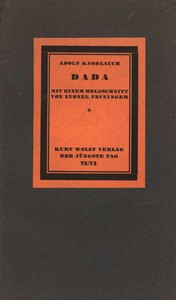
Dada by Adolf Knoblauch
I picked up 'Dada by Adolf Knoblauch' expecting a straightforward history lesson. What I got was something much better: a front-row seat to an artistic riot. Knoblauch, who was part of the original Zurich Dada circle, doesn't just describe events—he throws you into the middle of them.
The Story
The book is a first-hand account of the Dada movement's explosive start around 1916. We follow Knoblauch and a band of refugees, poets, and artists—people like Hugo Ball, Tristan Tzara, and Emmy Hennings—as they gather in neutral Switzerland. Sickened by the pointless slaughter of World War I, they decide to fight madness with more madness. They invent 'anti-art' in a tiny, smoky club called the Cabaret Voltaire. The plot is their nightly struggle to outdo each other in absurdity: reciting nonsense poems while dressed in cardboard tubes, making chaotic collages from newspaper scraps, and performing sounds that weren't quite music. It's the story of how a group of friends, through sheer audacity and humor, sparked a revolution.
Why You Should Read It
This book works because it feels like a secret diary. Knoblauch’s tone is conversational and often witty. You get the sense of the personalities clashing and collaborating, the inside jokes, and the sheer, giddy energy of creating something entirely new. He captures the spirit of Dada perfectly—it wasn't just about being weird; it was a passionate, angry, and hopeful scream against a broken world. Reading it, you understand that the glue that held this 'non-movement' together was human: friendship, shared exile, and a desperate need to laugh so they wouldn't cry.
Final Verdict
This isn't a heavy, academic tome. It's a quick, lively, and human-scale look at a pivotal moment. It’s perfect for anyone curious about modern art but intimidated by dry analysis, for creative people who need a reminder that rules are meant to be broken, and for history fans who want to feel the texture of life a century ago. If you’ve ever looked at a modern art piece and thought, 'I don’t get it,' this book might be the best backstory you’ll ever find.
This historical work is free of copyright protections. Feel free to use it for personal or commercial purposes.
John Johnson
7 months agoFrom a researcher's perspective, the clarity of the writing makes even the most dense sections readable. This has become my go-to guide for this specific topic.
Paul Thomas
7 months agoA must-have for graduate-level students in this discipline.
Emily Davis
8 months agoThe balance between academic rigor and readability is perfect.
George Davis
7 months agoWhile browsing through various academic sources, the evidence-based approach makes it a very credible source of information. A solid investment for anyone's personal development.

Donald Garcia
6 months agoMy first impression was quite positive because the way the author breaks down the core concepts is remarkably clear. I'm glad I chose this over the other alternatives.