
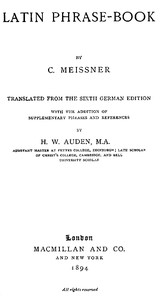
Latin Phrase-Book by Carl Meissner
Let's be clear from the start: this is not a storybook. There's no plot in the traditional sense. Published in the late 19th century, Carl Meissner's Latin Phrase-Book has a simple, almost quaint mission. It aims to prove that Latin, the language of ancient Rome, is still perfectly useful for modern life. The 'story' is Meissner's systematic, chapter-by-chapter argument for this idea.
The Story
The book is organized by theme, like a travel phrasebook. But instead of 'Where is the hotel?' you get chapters on Social Relations, The State, War, Science, and Commerce. Meissner fills these sections with ready-made Latin sentences for contemporary situations. He provides the Latin, a literal translation, and a polished English version. So, you can learn how to say 'The telegram was incorrectly delivered' or 'The shares have fallen considerably.' He covers everything from boarding a train ('Locomotiva iam vaporibus plena est' – The locomotive is already filled with steam) to discussing parliamentary procedure. The entire book is his evidence, his case file, proving that no modern concept is beyond the reach of a properly constructed Latin phrase.
Why You Should Read It
This is where the magic happens. The joy isn't in memorizing the phrases (unless you really want to). It's in the glimpse into Meissner's mind and his era. Reading this is like finding someone's intensely detailed, slightly obsessive hobby project. You feel his passion and his peculiar conviction. Each page is a small, delightful collision between the ancient and the modern. It's unexpectedly funny and deeply human. You're not just learning that 'airship' is navis aëria; you're seeing a 19th-century scholar look at a newfangled balloon and insist, 'The classical world had a word for this... or it should have.' It turns a dry reference into a personality-driven artifact.
Final Verdict
This book is a hidden gem for a specific kind of reader. It's perfect for history nerds who love social curiosities, for Latin students who need a good laugh, and for anyone who enjoys 'weird old books' that reveal the past in unexpected ways. Don't buy it to become fluent. Buy it to meet Carl Meissner and spend a few hours in his wonderfully anachronistic world, where the key to understanding the industrial age was, apparently, hidden in a grammar book written two thousand years prior.
This publication is available for unrestricted use. Distribute this work to help spread literacy.
Kimberly Thomas
1 year agoClear, concise, and incredibly informative.
Charles Martin
6 months agoI started reading this with a critical mind, the critical analysis of current industry standards is very timely. Definitely a five-star contribution to the field.
James Thomas
4 months agoI appreciate how this edition approaches the core problem, the author’s unique perspective adds a fresh layer to the discussion. Definitely a five-star contribution to the field.
Michael Garcia
3 months agoClear, concise, and incredibly informative.







Joseph Lee
9 months agoI appreciate how this edition approaches the core problem, the way it handles controversial points with balance is quite professional. This is a solid reference for both beginners and experts.