
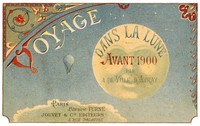
Voyage dans la lune avant 1900 by A. de Ville D'Avray
So, here’s the deal with this 1864 French sci-fi curiosity. The story is straightforward but packed with wild ideas. A brilliant but eccentric scientist, Dr. Baguette, becomes obsessed with reaching the moon. Instead of a fancy rocket, he opts for the most 19th-century solution imaginable: a massive, earth-shaking cannon. He builds a special projectile, climbs inside with his trusty dog, and—BOOM—gets launched into the void.
The Story
After a harrowing journey, he crash-lands (gracefully, of course) on the lunar surface. But this isn't the dead rock we know. Ville D'Avray’s moon is a lush, alien world with glowing forests, giant crystals, and an atmosphere. He soon encounters the Sélénites, the moon's inhabitants. They’re tall, graceful, and communicate through a kind of telepathy or music, not speech. There are no cities or wars here; it’s a serene, almost utopian society that lives in harmony with its environment. The "plot" is really about the doctor exploring this world and trying to understand its people and their peaceful, advanced philosophy. The tension comes from his own human limitations bumping up against their incomprehensible perfection.
Why You Should Read It
What grabbed me wasn't the action—there isn't much—but the sheer audacity of the vision. This was written when space travel was pure fantasy. Ville D'Avray isn't worried about science; he's dreaming. The book feels less like an adventure and more like a gentle, philosophical trip. The Sélénites are fascinating because they hold up a mirror to humanity's flaws—our noise, our violence, our clutter—without ever being preachy. Reading it, you get this wonderful sense of historical whiplash. You can see the seeds of later sci-fi tropes, but they're wrapped in a totally different, almost poetic sensibility. It’s quiet, strange, and oddly beautiful.
Final Verdict
This isn't for someone looking for a fast-paced space opera. It's a slow, thoughtful stroll through a 19th-century dream of the cosmos. Perfect for history buffs curious about the roots of science fiction, or for readers who love finding obscure gems. If you enjoy early Verne or the philosophical side of H.G. Wells, and don't mind a story that values big ideas over big explosions, you'll find this short voyage utterly captivating. Think of it as a peaceful postcard from the very edge of Victorian imagination.
Legal analysis indicates this work is in the public domain. You do not need permission to reproduce this work.
Dorothy Ramirez
4 months agoThis is one of those stories where the storytelling feels authentic and emotionally grounded. Exactly what I needed.
Paul Brown
1 year agoTo be perfectly clear, the character development leaves a lasting impact. I would gladly recommend this title.
Sarah Thompson
9 months agoI have to admit, the atmosphere created is totally immersive. Definitely a 5-star read.
Joseph Jones
11 months agoThe index links actually work, which is rare!







Barbara Hill
1 year agoTo be perfectly clear, the arguments are well-supported by credible references. I would gladly recommend this title.