
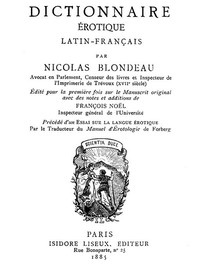
Dictionnaire érotique Latin-Français by Nicolas Blondeau
Let's get this straight from the start: this isn't a novel with a plot. There's no hero's journey or shocking twist on page 200. ‘Dictionnaire érotique Latin-Français’ is a reference book, a specialized dictionary written by Nicolas Blondeau and published in 1865. Its ‘story’ is the story of its own existence. Blondeau, a professor, took the formal, rigid structure of a classical Latin dictionary and filled it with the vocabulary of desire, intimacy, and the body—all the words that were carefully scrubbed from the standard textbooks used in schools and universities.
The Story
Imagine a scholar in 19th-century France, surrounded by strict social rules about propriety. He spends his days teaching the ‘noble’ works of Cicero and Virgil. But at night, perhaps, he dives into a different side of the ancient world. He combs through Roman poetry, graffiti from Pompeii, and satirical plays, collecting the slang, the jokes, and the straightforward terms for sex and anatomy that reveal how people really lived and spoke. He then carefully translates these terms into French and publishes them under his own name. The ‘conflict’ is right there in the title: the clash between the buttoned-up era it was published in and the unabashed content inside. It’s a quiet act of subversion, preserving a part of language that polite society wanted to forget.
Why You Should Read It
This book is a joy for anyone curious about history, language, or human nature. It completely shatters the illusion of the ancient Romans as just toga-wearing philosophers. Suddenly, they're real people with a rich, colorful, and often funny vocabulary for all aspects of life. It’s also weirdly moving. Blondeau wasn't just making a dirty list; he was doing real philology, tracing word origins and usage with academic care. He treated this ‘taboo’ language with the same respect as epic poetry. For me, that’s the most compelling part. It reminds us that our own hang-ups are temporary, and that the full spectrum of human experience, including how we talk about it, deserves to be remembered.
Final Verdict
This is a perfect pick for language nerds, history lovers with a sense of humor, and anyone who enjoys seeing the cracks in a ‘proper’ historical facade. It’s not a cover-to-cover read; it’s a book to dip into, to laugh at, and to marvel over. If you’ve ever looked at a dry academic text and wondered what it was leaving out, Blondeau’s dictionary is your answer. It’s a brilliant, bizarre, and utterly human artifact.
This book is widely considered to be in the public domain. Thank you for supporting open literature.
Richard Williams
1 year agoGreat value and very well written.
Sarah Moore
9 months agoHaving explored several resources on this, I find that the author’s unique perspective adds a fresh layer to the discussion. A refreshing and intellectually stimulating read.
Matthew Hernandez
7 months agoImpressive quality for a digital edition.
Barbara Jackson
9 months agoThe digital formatting makes it very easy to navigate.




Thomas Williams
2 years agoIt’s rare to find such a well-structured narrative nowadays, the argument presented in the middle section is particularly compelling. I'm genuinely impressed by the quality of this digital edition.