
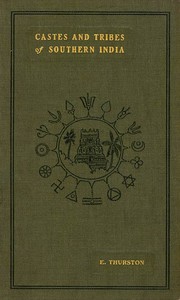
Castes and Tribes of Southern India. Vol. 1 of 7 by Edgar Thurston
Let's be clear from the start: this isn't a book you read cover-to-cover for fun. 'Castes and Tribes of Southern India' is a seven-volume encyclopedia, and this is just the first giant piece. Published in 1909, it was part of a huge colonial project to document and classify the people of India. Edgar Thurston, the superintendent of the Madras Museum, was the compiler. He didn't create a narrative; he assembled entries. Each one describes a specific community—sometimes just a few paragraphs, sometimes pages long. You'll find notes on their traditional jobs, their religious customs, their clothing, and their social standing.
The Story
There's no plot. Instead, imagine a massive, organized list. The book is arranged alphabetically, starting with communities like the 'Adi Andhra' and going from there. For each group, Thurston pulled together information from earlier reports, his own travels, and interviews. He describes festivals, burial practices, and legends. He also includes anthropometric data—measurements of people's height and head shape—which was a misguided attempt to find scientific categories for social groups. The 'story' is the portrait that emerges when you step back: a mosaic of hundreds of distinct ways of life, all existing side-by-side in one region, suddenly frozen in time by an outsider's pen.
Why You Should Read It
You don't read this for Thurston's analysis. You read it for the raw material. It's a primary source, a window. Skimming through it, you get an incredible sense of the sheer diversity of South Indian society. The details are sometimes mundane, sometimes extraordinary. But you have to read it carefully. You're constantly aware that this is one man's perspective, shaped by his era and his role in the colonial government. The book makes you ask questions: What did these communities think of being studied like this? What did Thurston get wrong? What cultural details did he miss entirely? It's as much about the observer as the observed.
Final Verdict
This is a specialist's book, but curious general readers can get something from it too. It's perfect for history buffs, anthropology students, or anyone with deep roots in South India looking for a historical record. It's not an easy read; it's a reference text. But dipping into a few entries is a powerful experience. It shows you a world being documented under a specific power structure. Think of it less as a definitive guide and more as a historical artifact—one that captures both the richness of human culture and the complexities of who gets to write it down.
This publication is available for unrestricted use. It is available for public use and education.
Sandra Thompson
1 year agoSurprisingly enough, it creates a vivid world that you simply do not want to leave. I learned so much from this.
Lucas Robinson
2 years agoSimply put, the atmosphere created is totally immersive. Worth every second.
Linda Davis
11 months agoRecommended.
Logan White
9 months agoTo be perfectly clear, it creates a vivid world that you simply do not want to leave. Don't hesitate to start reading.







Ethan Lopez
3 months agoClear and concise.