About 410 minutes
There is a tide — Reading Companion
Historical Psychological Social Fiction
94,076 recorded words. 9 minutes difference from this book's estimate.
View Gutenberg source #73250
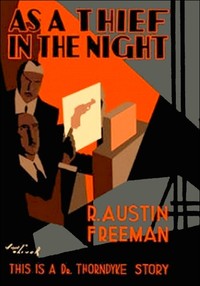
Before opening As a thief in the night — Reading Notes, the edition data offers a quick orientation: 92,016 words, 6 hr 41 min estimated reading time, and 21 detected text sections.
The text analysis averages about 17.7 words per sentence, while the detected sections provide another way to judge how the source is divided.
Project Gutenberg metadata also associates the work with “Detective and mystery stories,” connecting these edition facts with the source record’s subject description.
Explore this collection
These alternatives are selected using recorded categories and estimated reading time.
About 410 minutes
Historical Psychological Social Fiction
94,076 recorded words. 9 minutes difference from this book's estimate.
View Gutenberg source #73250About 412 minutes
Historical Psychological Social Fiction
94,691 recorded words. 11 minutes difference from this book's estimate.
View Gutenberg source #69777About 388 minutes
Historical Psychological Social Fiction
89,235 recorded words. 13 minutes difference from this book's estimate.
View Gutenberg source #68763Search stored excerpts and compare books → Choose by your preferences →
Choices use stored catalog measurements. Estimates vary with reading speed. A shared category is a catalog label, not a claim that two books have the same argument or literary quality.
Search reads excerpt text stored with this catalog and links to its associated Gutenberg record. The connection is stored in the site database; this tool does not recheck that every excerpt is word-for-word identical to that external record. Excerpt search does not cover every chapter and does not verify historical publication dates.
Catalog snapshot checked: 2026-09-25. Coverage: 100 public books, 100 available source excerpts.
Read the complete public-domain text at its original source.
Read on Project GutenbergThe novel opens with a retrospective narrator, Mayfield, who immediately establishes a pattern of hindsight: 'Looking back on events by the light of experience I perceive clearly that the thunder-cloud which burst on me... had not gathered unseen.' This framing device sets up a structure where the reader is constantly aware of impending disaster, yet the narrative unfolds through a series of seemingly ordinary domestic scenes. The first chapter introduces the Reverend Amos Monkhouse's arrival at his brother Harold's house, a setting that will become a locus of tension. Freeman contrasts the frail Harold with his energetic brother, and the absent Barbara, whose political activities hint at a broader social world beyond the sickroom. The opening thus establishes a rhythm of expectation and disappointment, where warnings are 'susceptible of interpretation only by means of the subsequent events.'
The novel's structure relies on a careful alternation between private, domestic spaces and the public, scientific realm of Dr. Thorndyke. The Monkhouse home is presented as a place of hidden vulnerabilities: the invalid Harold, the absent Barbara, and the unsettling arrival of the clergyman. Freeman uses the house as a stage for psychological tension, where conversations in drawing-rooms and sickrooms carry undertones of menace. In contrast, Thorndyke's laboratory is a space of methodical revelation, where X-rays and fluorescent screens render the invisible visible. The movement between these settings—from the claustrophobic interiors of the Monkhouse residence to the orderly, well-lit laboratory—mirrors the narrative's shift from subjective anxiety to objective inquiry. The reader, like Mayfield, is shuttled between these worlds, never fully at home in either.
Freeman employs the X-ray examination of a suspicious parcel as a pivotal scene that encapsulates the novel's thematic concerns. The description of the Crookes's tube, the 'green light,' and the 'fluorescent screen' is rendered with technical precision, yet the effect is deliberately uncanny: 'the parcel became invisible but in its place appeared the shadow of a pistol.' This moment transforms the ordinary—a package—into a site of hidden danger. The X-ray does not merely reveal; it replaces the visible with a ghostly trace, a shadow that is more truthful than the surface. The scene also introduces a note of dark humor through Polton's dismissal of the device as a 'booby-trap' from a 'mischievous boy of ten,' undercutting the gravity of the threat. This interplay between scientific seriousness and mechanical absurdity is a recurring note in Freeman's handling of forensic detail.
Throughout the excerpts, images of concealment and exposure recur with insistent regularity. The 'thunder-cloud' of the opening metaphor suggests a natural force that is both hidden and imminent. The parcel itself is a literal container of threat, its 'disguised handwriting' and 'special direction' marking it as suspect. Even the characters are presented in terms of visibility and invisibility: Mayfield notes that the clergyman 'looked at me... curiously,' as if trying to 'fit you with a visible personality.' Barbara is absent, her political activities placing her outside the domestic frame. The X-ray scene literalizes this pattern, making the hidden visible while simultaneously reminding the reader that not all threats can be so easily unmasked. The novel's title, drawn from a biblical allusion to a thief in the night, reinforces this sense of sudden, unannounced intrusion.
The narrative is structured around a series of arrivals and departures, each carrying a charge of potential revelation. The Reverend Monkhouse's arrival, Barbara's absence, the delivery of the parcel—these events create a rhythm of expectation that is often deferred. Mayfield's retrospective narration means that the reader is always slightly ahead of the characters, aware that the 'premonitory mutterings' will soon become thunder. Yet Freeman withholds full clarity, doling out information through dialogue and observation rather than omniscient summary. The reader is placed in a position similar to Mayfield's: present at key moments but lacking the full picture. This technique generates a sustained unease, as the ordinary details of domestic life—a maid's announcement, a brother's visit—become freighted with significance. The novel's structure thus mirrors its thematic concern with the hidden within the familiar.
Readers attentive to the novel's spatial and imagistic patterns will find that Freeman's method rewards close attention to the movement between rooms and the objects that populate them. The X-ray scene, in particular, offers a key to the novel's epistemology: surfaces are deceptive, and truth emerges only through specialized scrutiny. Yet the narrative also suggests that some threats remain stubbornly invisible, lurking in the gaps between what is said and what is seen. Approach the text as a series of scenes to be examined rather than a puzzle to be solved, and the novel's quiet tensions will gradually come into focus.
I’ve always found something shared between Freeman’s careful unravelling of hidden threats in a quiet home and the solitude in Children of loneliness — Background and Themes. Both know how a room can hold what we don’t yet see—the ache beneath a chair, the pause before a knock. A gentler kind of knowing, that one. I still think on it.
Capture what you thought, learned, and would like to remember.









